Feminine Expression

If you’ve been in Paris, you might have noticed how little color is actually worn around. Even the colors I do own in my closet hardly gets worn over the black, white, and grey options; It feels safer, easier, and more comfortable, color draws too much attention.

After arriving in Auroville, I don’t think there were many times at all where I saw women without flowers in their hair, dressed in colorful saris or lenghas, and vibrant colorful jewelry. I was first most impressed by the dedication and time that Tamil women put into their appearance, for their hair to be perfectly in place, decorated beautifully and complexly by pinned flowers that somehow manage not to fall out. Lenghas and saris came in more colors than I could ever feasibly imagine to be in my own wardrobe, women I saw consistently such as crocheters and sewers at AVAG came in with different jewelry and scarves to match different saris. On New Year’s Eve, all of the women at AVAG had decided to come to work matching in the same teal blue, I had noticed and complementarily pointed it out, and shared giggles and smiles between the women pursued. These were the kind of experiences that I understood so well without being able to actually understand the language exchanged. I experienced so many times how often women engaged to share feminine experiences with me, putting flowers in my hair, bindis on my forehead and bangles on my wrist; even if we shared no common language, we shared our own language of being a woman.

One Auntie, who I had met during an AVAG event, insisted on buying me a pack of bangles from the village shop, I profusely denied her offer until I had no other choice. She asked me which color I liked and I chose the white plastic ones. She looked at me shocked, proceeded to tell me no, and chose a set of blue ones and pointed to my eyes as she gave money to the shop tender and put them on my wrist. I habitually avoid color in my everyday life, but seeing other women embrace it so much, without trying to “seem cool”, and expressing themselves through their appearance so wholeheartedly, and for some, in the only way they can. I then decided that one of my New Years resolutions would be to wear more color, because it’s fun and beautiful, but also a rich tradition cross-culturally for women to express themselves.

A couple of months later, I wore an all pink outfit, something I normally do not do. As I stood at the bus stop on the way to school, an older woman stood next to me, giving me a smile as she looked up and down, a nonverbal communication of femininity and female expression that felt familiar.

by Carol Ann Norris
Taking things slower

Throughout my time in Auroville, the same lesson kept creeping into my experiences and my mind. It first came to me within the first couple of yoga lessons with Natasha, she asked us to be more conscious of our bodies and what they’re feeling. I hadn’t realized it, but every time she asked us to “check” our bodies, I had to slow down my breath and actually become aware of my conscious self. I hadn’t realized how my anxious ticks and general anxiety infiltrated my body in the way it did. It was tension that I felt in my shoulders and even in my tongue, as I don’t think any part of myself ever calmed down and completely relaxed unconsciously. 


Later, we attended the awareness through the body workshop, which reinforced this same idea. My anxiety stayed present, even when I wasn’t aware of it; my body was not relaxing, even when I thought it was. How much negativity and stress is my body feeling subconsciously?

Auroville was practically a signal-blocked zone, yet I found myself subconsciously opening my phone even when it wasn’t functional, even opening TikTok, which is inaccessible in India; these movements don’t even feel like my own, manufactured by my own consciousness. Even the burdens of the internet have infiltrated my mind’s connection with my hands and body.

I took this into mind during my time in Auroville, especially when riding around on my bike, I reminded my body to relax and calm down. I promised myself that I would bring these practices back to Paris and into my life in general. After my time in India, I found out that the feeling I was describing, of my body not relaxing, even my breath, is a sign of high-cortisol, which is essentially high-stress, which can take major tolls on the body and its processes, including muscle weakness, high blood pressure, and the disruption of sleep cycles. The body’s processes are deeply connected with each other, and while it seems intuitive, it feels easy to forget, especially in environments where we are more deeply attached to technologies and our anxieties than our own conscious self and our personal well-being.

by Carol Ann Norris
Reintroducing the Sahodaran Community Oriented and Health Development Society

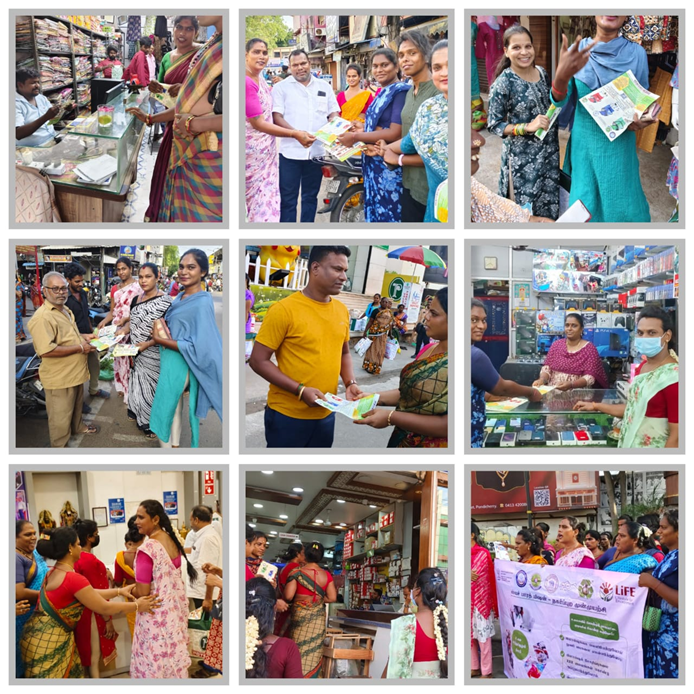
Photo is derived from the 2024-2025 SCHOD Annual Report

Around the world, marginalized communities continue to face barriers to healthcare, social acceptance, and equal rights. In India, many transgender and LGBTQ+ individuals encounter discrimination, limited access to healthcare, and social exclusion. The Sahodaran Community Oriented and Health Development Society (SCOHD) was created to address these challenges and to provide support, advocacy, and resources for those who need them most.

Founded in 1998 in Pondicherry, Tamil Nadu, by Dr. Sheetal K., SCOHD became a community-based non-governmental organization dedicated to empowering LGBTQ+ individuals and men who have sex with men (MSM) through health initiatives, education, and social advocacy. The organization’s mission is to create a safe and supportive space where individuals can live authentically, access essential services, and build a stronger sense of community. The name Sahodaran, meaning “brother,” reflects the organization’s core value of solidarity and collective support.

Photo derived from the 2022-2023 SCHOD Annual Report

At the heart of SCOHD’s work is the belief that healthcare and human dignity should be accessible to everyone. The organization provides vital health services including HIV/AIDS education and prevention, mental health counseling, gender-affirming healthcare guidance, and sexual health education. These initiatives help address gaps in healthcare access that many transgender and LGBTQ+ individuals experience due to social stigma and systemic inequality. By offering counseling, testing resources, and preventative education, SCOHD plays an important role in promoting healthier communities.

Beyond healthcare, SCOHD is committed to strengthening the social and economic well-being of the communities it serves. The organization offers legal aid, protection against discrimination and violence, and skill-building programs that empower individuals to pursue sustainable livelihoods. Through workshops, community discussions, and advocacy campaigns, SCOHD also works to challenge societal stigma and promote broader understanding of gender diversity and sexual orientation.

SCOHD’s impact extends beyond individual services. By engaging in public advocacy and education, the organization contributes to broader efforts for equality and social justice in India. It has participated in awareness campaigns and community initiatives aimed at reducing discrimination and improving public understanding of LGBTQ+ rights. Through collaboration with community members, healthcare providers, and activists, SCOHD continues to help shape a more inclusive society where marginalized voices are recognized and respected.

The creation of this website serves as a digital platform to highlight the important humanitarian work carried out by SCOHD. It brings visibility to the organization’s mission, programs, and the stories of the communities it supports. By sharing this information with a global audience, the website aims to foster awareness, encourage dialogue, and inspire support for initiatives that promote equality, health, and human dignity.

The work of the Sahodaran Community Oriented and Health Development Society reminds us that meaningful change begins at the community level. Through compassion, advocacy, and collective action, SCOHD continues to build pathways toward a future where every person, regardless of gender identity or sexual orientation, can live with dignity, safety, and opportunity.

Written with great pleasure by Sophia Diaz

May you all choose kindness everyday.

Is the Group Sex Thing Optional? A speculation on Auroville’s nature: cult, colonial settlement, or something else entirely 

Auroville is truly one of a kind.

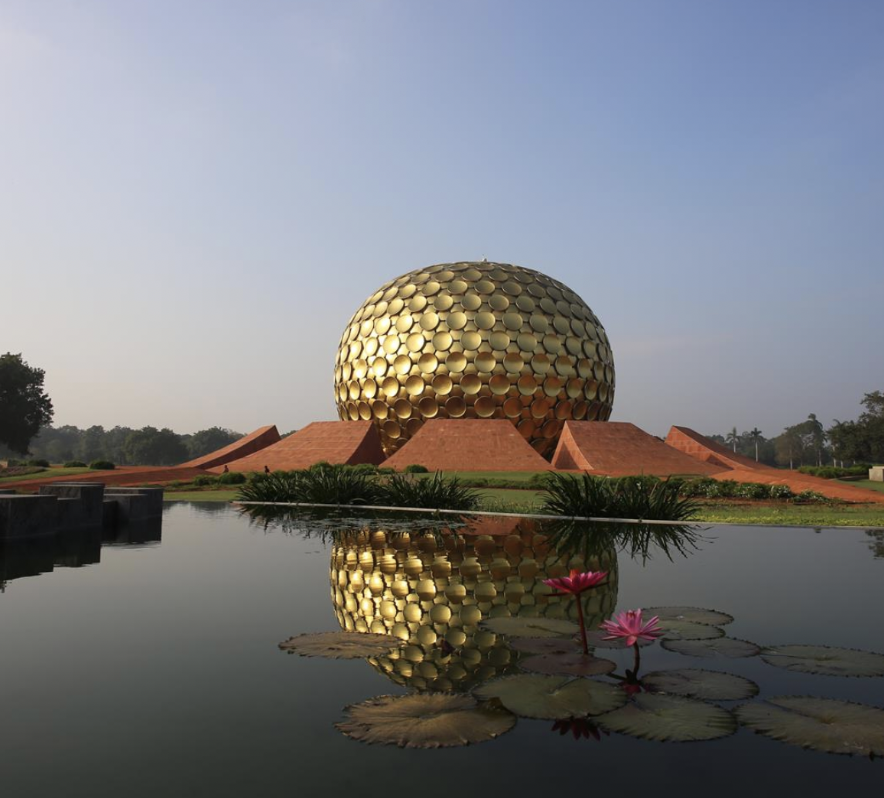
   Image retrieved from the Auroville.org

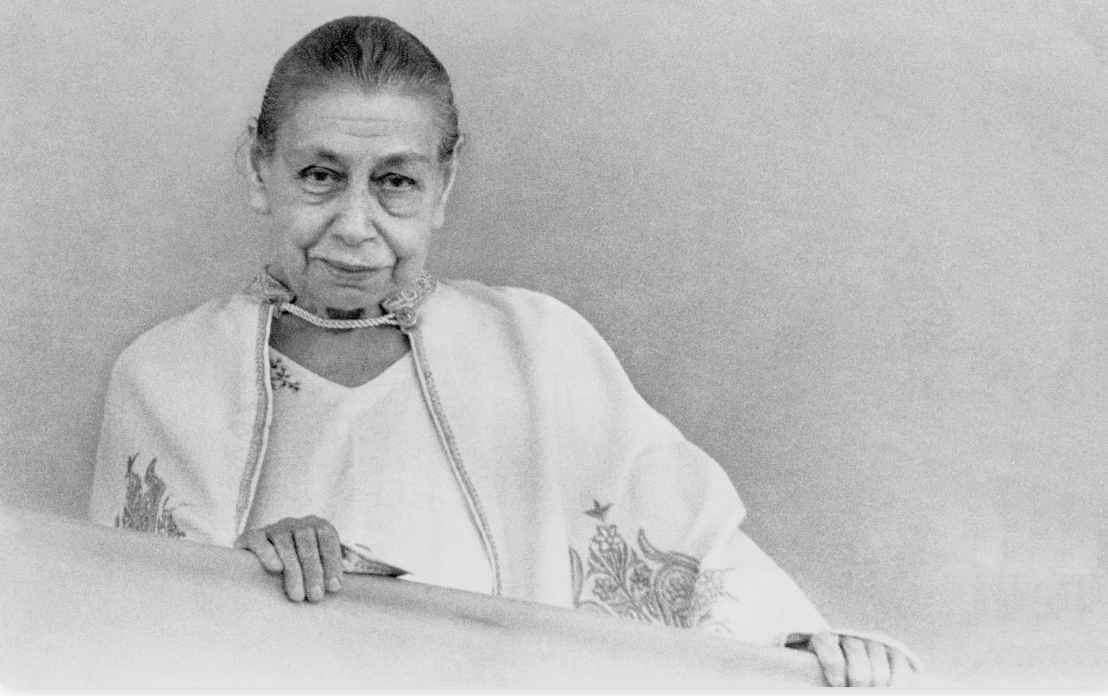
Nestled in the coastal region of Tamil Nadu, India, Auroville is often described as a “universal township.” Founded in 1968 by Mirra Alfassa (known as “the Mother”), it was conceived as a living laboratory for human unity, sustainability, and conscious evolution. Officially endorsed by UNESCO and supported by the Government of India, Auroville aims to transcend national, political, and religious divisions.

Yet, for all its noble aspirations, Auroville invites questions—some practical, some philosophical, and some deeply personal. During my time there, I found myself grappling with its contradictions and complexities. Is it an inspiring model for the future, or does it echo troubling patterns of the past?

     Image retrieved from the Auroville.org

Beyond the “Cult” Label — A Reflection on Devotion and Perception

Before arriving, my friends and I half-joked that Auroville sounded like a cult. Merriam-Webster defines a cult in several ways:

cult noun

1: a group (as an organization or religious sect) with tenets and practices regarded as coercive, insular, or dangerous

2: great devotion to a person, idea, object, movement, or work

3: a system of religious beliefs and rituals

4: formal religious veneration : worship

5: a system for the cure of disease based on dogma set forth by its promulgator

After a month in Auroville, I observed that while residents hold deep reverence for the Mother’s vision, the community does not align with the coercive or insular aspects of the definition. There is no centralized authority demanding conformity, and residents are free to leave at any time.

What fascinated me was my own discomfort with their devotion. As an American, I grew up celebrating the “Founding Fathers” as visionary leaders. Why did their veneration feel normal, while the Mother’s felt cultish? I began to wonder: Was I reacting to internalized biases—perhaps a subconscious sexism that questions spiritual authority when it comes from a woman?

         Image retrieved from the Auroville.org

Colonial Echoes or Conscious Integration?

Another layer of unease came from Auroville’s location and demographic makeup. The Mother was French, not Indian, and the surrounding region of Puducherry bears a visible French colonial legacy—from street names to architecture. Today, French remains the second-most common nationality in Auroville after Indian.

This raised difficult questions: Why establish such an experiment in post-colonial India? Was this another instance of the Global North using the Global South as a testing ground?

             Image retrieved from Travel India.

All of these things made me curious. Why India? Why isn’t Auroville in France? What about the conditions in India made it ideal for an experiment like Auroville to take root? Is this another instance of the global north using the global south how they see fit? Experimenting in someone else’s backyard?

Yet the reality is more nuanced. According to Auroville’s 2025 census, the community of 3,296 residents includes 1,702 Indians—making up over half the population. The top five nationalities are:

  1. India 1702 residents
  2. France 401 residents            
  3. Germany 227 residents                  
  4. Italy 164 residents         
  5. USA 100 residents    

During my stay, I noticed deliberate efforts to honor Tamil culture—through language classes, traditional crafts, and ecological restoration projects on once-degraded land. The ideal, as one resident told me, is “integration, not imposition.” Whether that ideal is fully realized remains an open question, but it complicates any simple colonial narrative. A melting pot is beautiful, as long as it is consensual and respectful of the native land and people.

               Image retrieved from the Auroville.org

The Lasting Impact — What Auroville Leaves Behind

Auroville lingers with you. Since returning home, I’ve found myself incorporating small rituals into daily life: morning yoga, mindful meals, watching the sunset, and a heightened awareness of waste and consumption. These weren’t rules imposed on me, but habits absorbed through living in a community that values intentionality.

Perhaps that’s Auroville’s most compelling quality: it defies easy categorization. It is neither utopia nor cult, neither colonial outpost nor native. It is a work in progress—a flawed, evolving experiment that challenges visitors to reflect on their own assumptions about community, belief, and belonging.

In the end, Auroville resists labels. And maybe that’s the point.

References:

Auroville vision and history: 

https://auroville.org/page/auroville-in-brief

Cult definition by Merriam Webster Dictionary:

https://www.merriam-webster.com/dictionary/cult

French colonial legacy in Southern India:

https://archive.org/details/historyoffrenchi00mall/page/n17/mode/2up

Auroville Census 2025:

https://auroville.org/page/census%20-%20auroville-population-539

Article by: Kylie Fast

Written on January 20th, 2026.

The Auroville Vegan Foodie Guide: A Plant-Based Paradise

Tucked away in Tamil Nadu, Auroville isn’t just an international township focused on human unity and sustainable living—it’s also a hidden gem for plant-based eaters. For vegans, it feels less like navigating dietary restrictions and more like discovering a culinary promised land. Rooted in the community’s core principles of environmental care and ahimsa (non-violence), Auroville’s food scene is a vibrant tapestry of organic farms, innovative cafes, and artisanal producers. From farm-to-table feasts to delectable desserts, every meal here tells a story of sustainability and flavor. This guide will lead you to the very best vegan delights Auroville has to offer.

Your Guide to Auroville’s Vegan Eats:

Solitude Farm Cafe

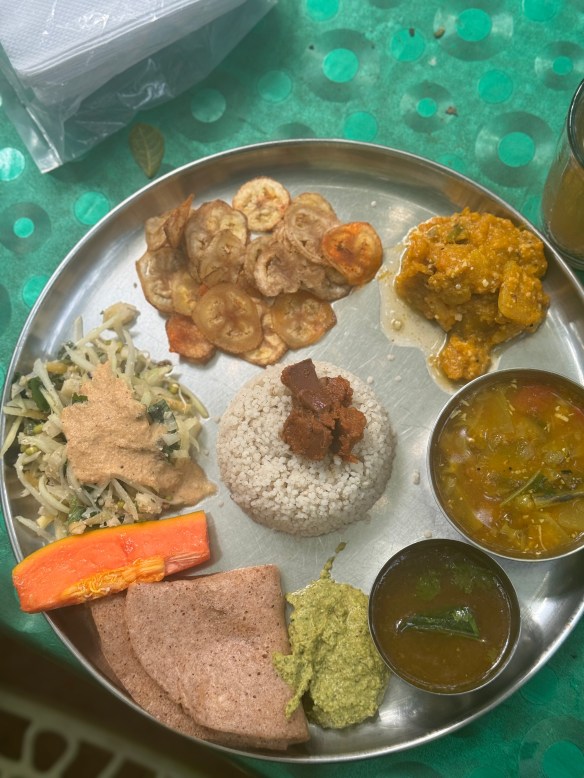
The true essence of Auroville’s farm-to-table ethos. Their daily-changing thalis are plated with hyper-local, often heritage, produce grown right on their permaculture farm. Don’t miss their refreshing and beautiful flower-infused coolers.

Marc’s Cafe

A beloved institution for coffee lovers. Their signature Cloud Coffee is a must-try—a creamy, frothy, coconut-y delight. They source their beans directly from farms in South India (like the Araku Valley or Nilgiris) and roast them on-site for exceptional freshness.

Bread & Chocolate

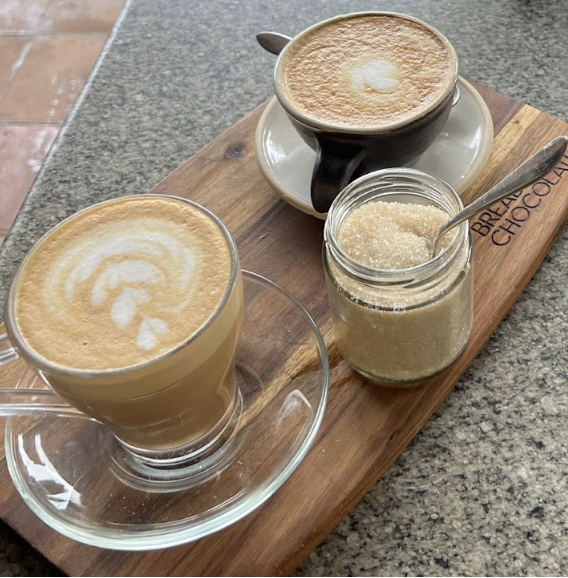
A haven for baked goods and sweet treats. Savor a rich brown sugar latte made with coconut milk, and be sure to take away their sourdough & seasalt dark chocolate bar—a perfect balance of tangy, salty, and sweet.

Conscious Cafe

True to its name, this spot offers globally-inspired, mindful cuisine. Their tofu satay with rich peanut sauce is a flavor-packed favorite. For a fun, fresh drink, order the vibrant ABC (apple, beet, carrot) juice.

Naturellement Garden Café

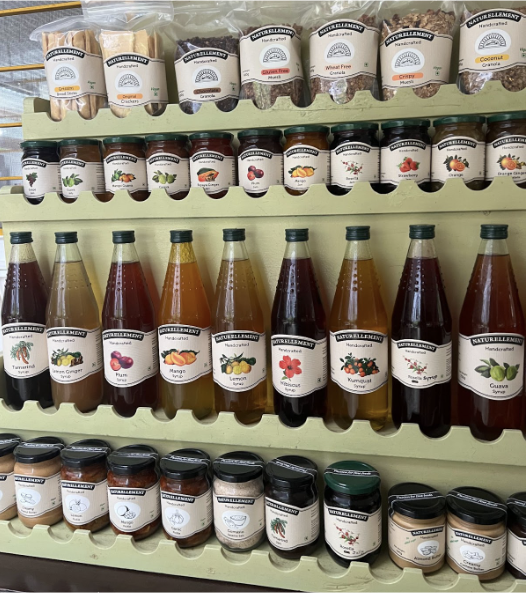
More than a café, this is a producer of Auroville’s finest artisanal products. Sip a mango smoothie made with fresh homemade coconut milk or the potent spirulina drink (featuring fresh Auroville-grown spirulina, lemon, and organic jaggery). This is also the best place to stock up on packaged (homemade!) vegan snacks like cookies, granola, and preserves.

Sudha’s Kitchen
A tiny spot with a huge reputation for raw, vegan, and sweet delights. Their vegan truffles, made with nuts, dates, and raw cacao, are little balls of pure deliciousness. You can also find takeaway packs of these little balls of heaven on lucky days in the refrigerated section at the grocery store Hers.

Image retrieved from Sudha’s Kitchen.

The Right Path Cafe

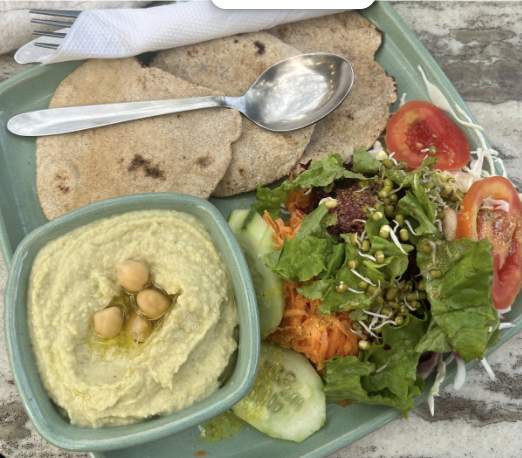
Offers wholesome, hearty meals in a convenient location when enjoying the myriad of activities offered at the Auroville Visitors Centre. The Mediterranean plate and comforting Vegetable Kurma with a fresh side salad are excellent choices. Always save room for their vegan brownie!

Sprout Cafe

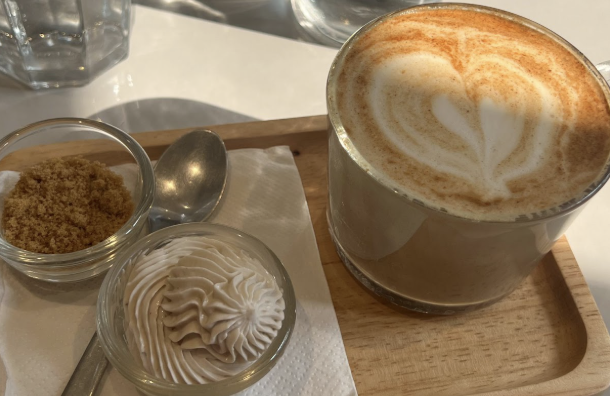
A breakfast and brunch superstar. Start with a vanilla cinnamon soy latte topped with vegan cream. Their vegan pancakes with date syrup are legendary, but the showstopper is “The Scramble”—featuring homemade bread, scrambled ‘eggs’ made from silky tofu, and homemade cocoa vegan butter. Yes, it’s all gloriously homemade!

Final Thoughts: More Than Just a Meal

Exploring Auroville’s vegan cuisine is about nourishing both body and spirit. It’s a taste of a community living its values, where every sip of coffee, bite of chocolate, or forkful of curry connects you to the land and a vision for a kinder future. Whether you’re a committed vegan or simply a curious foodie, these eateries offer an unforgettable journey into the heart of conscious cooking. So come hungry, leave inspired, and take the ethos of mindful, delicious eating with you long after you’ve gone.

Article and images by: Kylie Fast

Featured image of Sudha’s Kitchen’s truffles by Sudha’s Kitchen.

Written on January 16th, 2026.

Pedal Powered Paradise

Experiencing the Freedom of Electric Bikes in Auroville

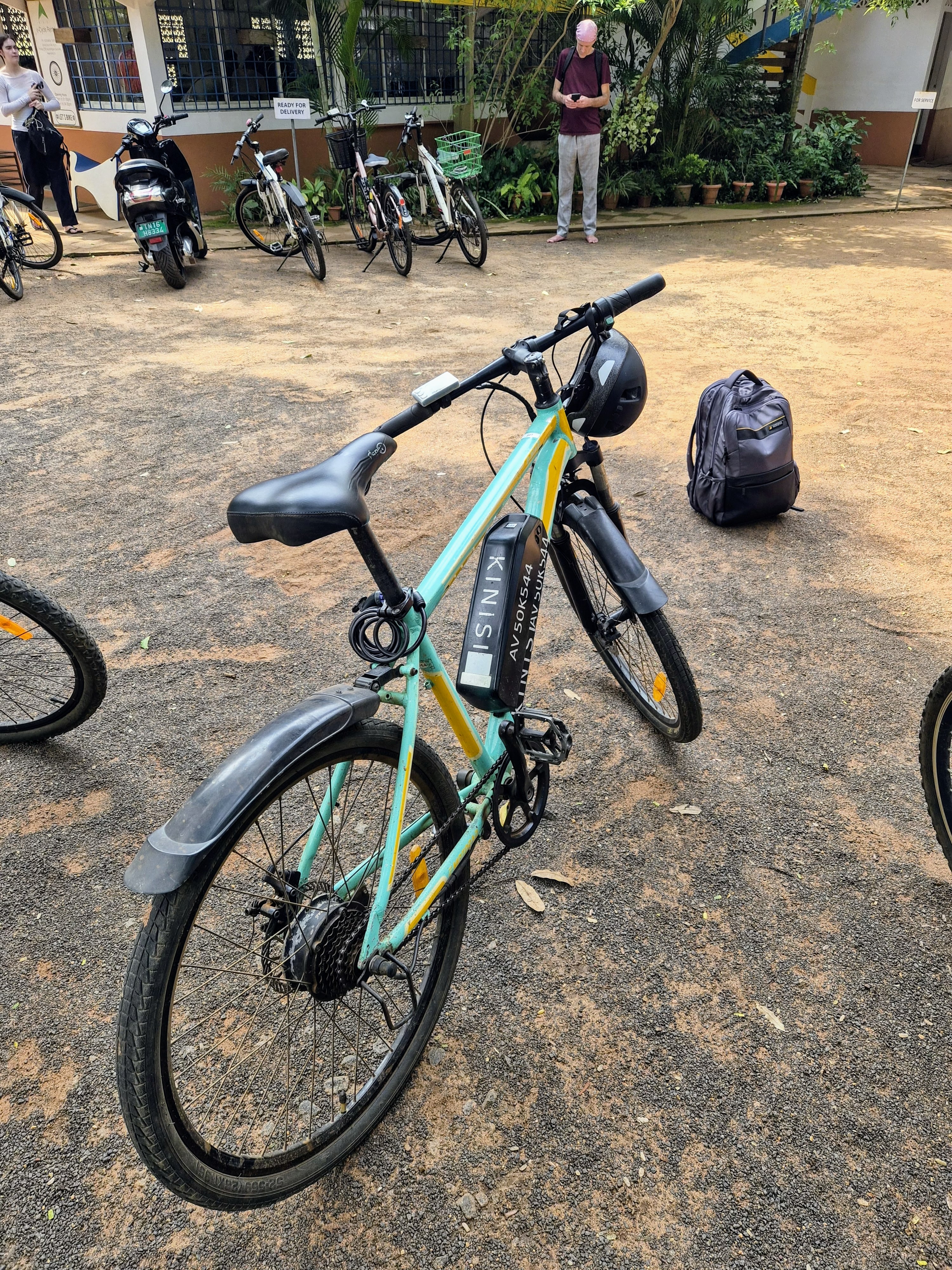
Nestled near the coastal town of Pondicherry, India, lies the extraordinary community of Auroville. This unique experiment in sustainable living and collective human unity offers a refreshing alternative to the hustle and bustle of modern Indian cities. While the spiritual depth of Auroville is undoubtedly a draw, my India Practicum trip was made truly memorable by the sheer joy and freedom of exploring the experimental township on an electric bicycle.

The Initial Thrill: More Than Just a Commute

Having some fear of navigating the standard forms of Indian transport,rickshaws, old taxis, or even the occasional over-packed bus the concept of an electric bike wasn’t entirely novel. Yet, within the boundaries of Auroville, it was a revelation. It wasn’t just about getting from point A to point B; it was about experiencing the journey.

Auroville isn’t an urban grid. It’s a sprawling ecosystem of diverse communities, known as ‘farms’ or ‘villages’, connected by winding red-dirt paths and shady lanes. These paths are designed for slower, more conscious movement, making standard vehicles seem clunky and intrusive. The electric bike, on the other hand, was the perfect fit.

The Freedom to Breathe and Connect

One of the first things you notice about cycling in Auroville is the silence. Gone is the incessant honking and engine roar that often dominates Indian roads. In its place, the gentle hum of the electric motor blends with the rustling of leaves and the songs of local birds. This creates an immediate connection to the environment that is impossible to achieve in a car or even on a motorbike.

This quietness is coupled with an unparalleled sense of physical freedom. The lightweight nature of the bikes, the gentle assistance from the motor, and the winding paths allow for effortless exploration. There’s no stress of traffic jams or finding parking. You simply park your bike on the side of the road and walk into a cafe, an art gallery, or a quiet forest glade. This effortless movement encourages spontaneity, making every detour an opportunity for a new discovery.

A Sustainable Solution for a Sustainable City

While the personal joy was evident, the use of electric bikes in Auroville goes beyond individual experience. It’s a core component of the community’s commitment to sustainable living.

One of Auroville’s key principles is to reduce its carbon footprint. The widespread use of electric bikes significantly contributes to this goal. These bikes are quiet, emit zero tailpipe emissions, and have a relatively low environmental impact compared to internal combustion engines. This helps keep the air clean and the soundscape peaceful, enhancing the overall quality of life in the community.

Moreover, the charging infrastructure for these bikes is integrated into Auroville’s renewable energy grid. Solar and wind power generators provide clean energy for the bikes, ensuring that even their operations are as sustainable as possible. This circular system reinforces the community’s commitment to creating a low-carbon society.

Lessons for a More Conscious Future

My experience with electric bikes in Auroville was more than just a fun holiday activity. It was a glimpse into a potential future—a future where transportation is silent, sustainable, and intimately connected to the environment.

The lesson for my India Practicum trip was clear: sustainable practices aren’t just about sacrifice; they can be about enhancing our daily lives. The simple act of riding an electric bike not only reduced my impact on the planet but also deepened my connection to the community and the natural world.

Auroville showed me that sustainable transport isn’t just a technical challenge; it’s a way to foster a deeper sense of connection and well-being. As I returned to the chaotic reality of standard transportation, I carried with me a new appreciation for the quiet freedom of the electric bike a simple yet powerful tool for a more conscious and sustainable future.

Casual Sustainability: How Auroville Made it the Norm

Throughout our time in Auroville, there was one key thing that stuck out to me: sustainability is typically discussed as something that requires an immense conscious effort, yet in Auroville it seems so second nature. The idea of implementing sustainable practices was a key part of Auroville since its creation, but it was the willingness of the community that got me thinking about what is missing in so many other places. I ended up narrowing it down to three main things: sustainability as structure, culture, and passion. 

Sustainability as Structure

You’ll oftentimes find when the topic of a more sustainable future is brought up in an attempt to enact laws, clarify regulation, or to implement policy, the immediate reaction is that it is inconvenient or expensive, falsely correlating sustainability with extra effort or wasted resources. 

Yet in Auroville, it wasn’t like that. Instead of sustainability being something extra that took away from time, it was just the standard.

The way I began thinking about it is how people talk about time. At some point in their life, almost everyone has wished for more hours in a day. But if everyone was all of a sudden given those hours, expectations of what you could accomplish would simply grow to fill them. 

Sustainability seemed to work in a similar way where when you become used to a certain level of “convenience” it starts to seem like a burden to engage in sustainable practices. Especially within companies, where those who are taking precautions to stay sustainable can feel like they are only incrementally as productive. When a community is set up to be unsustainable and sustainability has to become the extra, where you have to go out of your way to find a recycling bin or where your competitors can make 50 products in an hour when you can only make 5, the community adapts to that mindset. 

But when we were confronted with no other option but to wash our dishes after we ate and to separate our trash, it simply became routine. Being unsustainable suddenly became the more difficult choice, it could cause problems, and it simply wasn’t what the community was set up for.

Whether we were watching people make bricks by hand, dye clothes with centuries-old techniques, or hand carve wooden tools, sustainability wasn’t “slower” or “a waste of time” it simply was how things were done. 

Sustainability as Culture

While that structure in Auroville was able to make sustainable behavior possible, the culture is what made it natural. Everywhere we went, nobody complained about how long something may have taken to create or about doing their part. 

There was such a strong culture of people naturally only taking what they needed and a respect for what was already there. Actions never had to be enforced through rules but rather just the expectations from the community itself. A beautiful example of how effort doesn’t need to seem like some burden but can instead become an easy part of life.

Over time it became clear that yes, Auroville was made to be a sustainable community and that is helpful, but it isn’t the rules that determined how sustainable people were, it was themselves. It helps to drag you out of the mindset that this is something you have to do and makes it feel like a choice that respects the Earth and those around you. 

Sustainability as a Passion 

Finally, the thing that I found to be the most important is the passion behind it all.

When sustainability gets brought up on a global scale, the reaction is typically pessimistic. You hear that meaningful change isn’t possible, the new rules will affect simplicity, and that we’re already too far gone. Whether it is separating trash, carrying a reusable bottle, or being a more thoughtful consumer, sustainability is mislabeled as an inconvenience. 

Before Auroville, I believed in this and thought that global sustainability was something impossible, requiring some cosmic shift in mindset. I was wrong. It was never a huge shift, just a rephrasing.

In Auroville I noticed something I can only refer to as casual sustainability. There was no cosmic shift in people or constant talk about how amazing certain actions are for the environment. Instead, there was a quiet sense of pride in everything that was done. As I mentioned, we handmade bricks, watched people dye clothing with original techniques, and learned about what it takes to craft baskets out of paper. None of these things were sustainable to appease customers or to improve CSR, there was a genuine investment in what people wanted to produce. And once again, this was just the norm. 

Ultimately that was the biggest thing I could have ever imagined taking away from our time in Auroville. We can all be sustainable if we set ourselves up to be, because sustainability becomes far more achievable when it stops being treated as a sacrifice and instead is treated as a habit. 

By: Julia Murdock

Selective Sustainability

During one of my interviews in Auroville, we were speaking passionately about environmental responsibility. About protecting water systems. About sourcing fabrics consciously. About extracting natural dyes from plants without harming the earth.

As we talked, cigarette smoke drifted between us.

At one point, the cigarette was pressed into the soil underfoot, the same soil from which plants are grown, and the same ground that supports the sourcing of materials and the creation of natural color.

The image stayed with me.

Not because it felt hypocritical. But because it felt human.

How often do we devote ourselves wholeheartedly to one aspect of sustainability while quietly neglecting another? How often do we protect the planet in one area while unintentionally harming it in another? The contradiction did not cancel out the passion I was witnessing. If anything, it made it more complex.

The cigarette became a sort of symbol to me. It reminded me that sustainability is rarely complete. We separate our ethics into different parts. We pour energy into the causes that move us most deeply, while other habits remain untouched, unquestioned, or postponed for later.

The 17 Sustainable Development Goals are interconnected for a reason. Environmental protection cannot be fully separated from human health. Care for the earth cannot be entirely divorced from care for the body. Sustainability is not only about materials, production methods, or business models. It is also about daily choices, consistency, and alignment.

That moment challenged me more than it judged anyone else. It made me ask myself where I practice selective sustainability. Where do my values and my habits fail to meet? Where do I protect one thing while ignoring another?

Maybe real sustainability is not about being morally perfect. Maybe it is about being aware. It is about noticing the small contradictions in our lives and slowly working to reduce them. It is about trying to bring things together instead of trying to be perfect.

We all practice sustainability in parts. The real work is learning how to bring those parts together into one whole.

By Sarah Azarian

What I Didn’t Expect to Learn About Sustainability in Auroville

Tibetan Flags In the Sky

Sustainability usually arrives with instructions. What to buy, what to avoid, what to fix, what to improve. It often feels like a checklist, or worse, a moral test.

Auroville didn’t work like that.

Instead of telling you what sustainable living is supposed to look like, it lets you notice it on your own. Over time, certain patterns start to repeat themselves. Not in an obvious way, and not as lessons exactly, but as everyday realities that slowly reshape how you think about comfort, excess, and value.

These are a few of the things that stood out.

1. Luxury Isn’t Always Designer

    In most urban settings, luxury is tied to choice and control. Being able to customize everything, upgrade constantly, and replace what no longer feels perfect is often treated as a sign of success. In Auroville, luxury shows up in quieter ways.

    Here, luxury looks like space to breathe, time without urgency, and environments that don’t ask you to perform. Comfort isn’t created through polish or aesthetics, but through ease. There’s less pressure to consume in order to belong, and more acceptance of what already exists.

    It reframes luxury as something experiential rather than material. Less about what you own, more about how you move through your day.

    2. Simplicity Works When It’s Normal

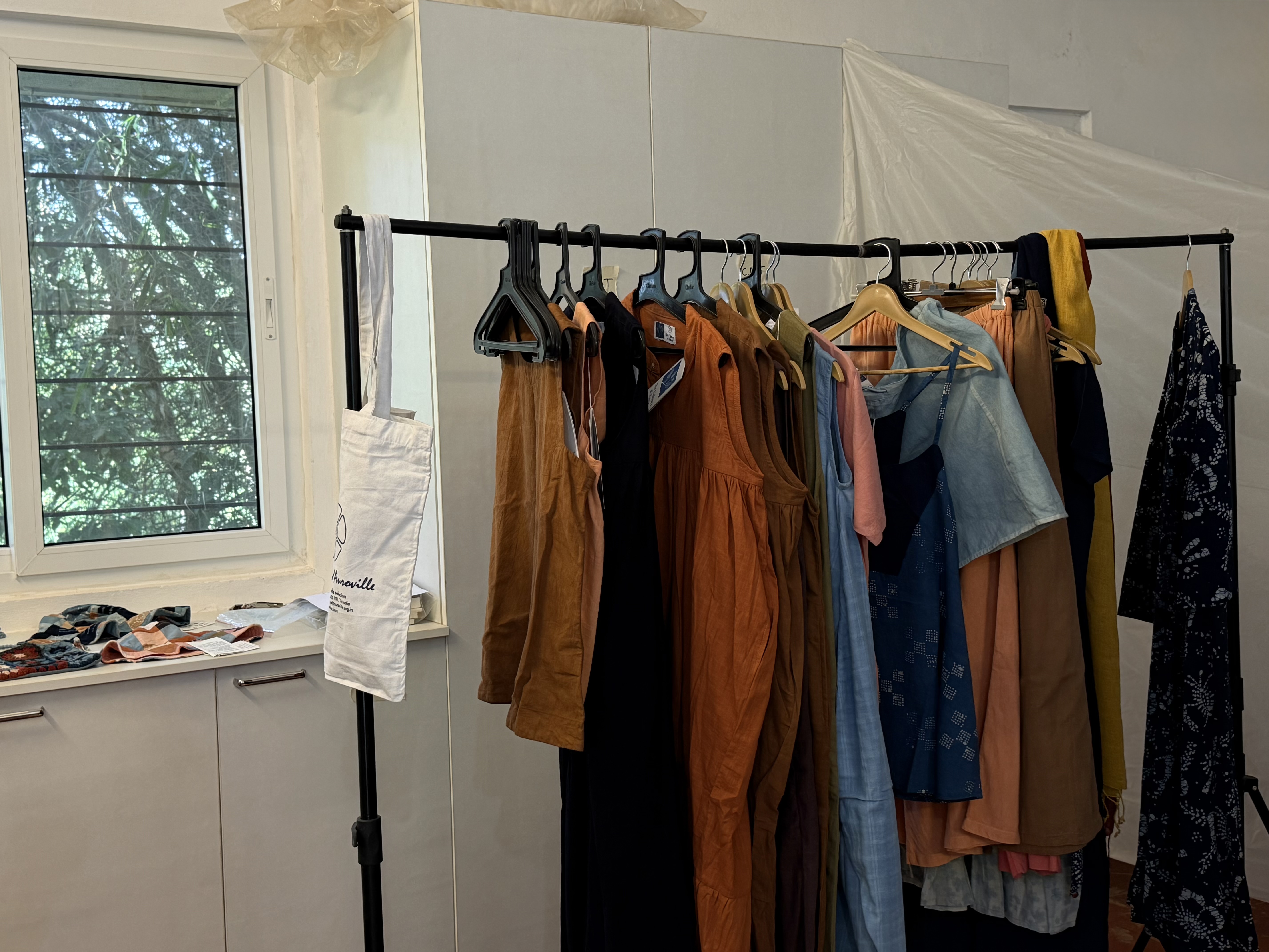
    Clothing Rack at Colors of Nature Photo Shoot

    One of the reasons sustainability feels achievable in Auroville is because it isn’t framed as a special effort. People reuse towels, share resources, and eat what’s prepared without much discussion. These practices aren’t highlighted or praised; they’re simply part of daily life.

    When simplicity is treated as normal rather than virtuous, it stops feeling restrictive. There’s no pressure to “do it right.” You adjust naturally, because that’s how the environment functions.

    This normalization makes sustainability feel less like a personal burden and more like a shared rhythm.

    3. Slow Is a Feature, Not a Bug

    Life in Auroville moves at a noticeably slower pace. Walking, cycling, and simple vehicles shape how people move through space. Distances feel longer, but time feels less compressed.

    At first, this can feel inefficient. Over time, it becomes grounding. Slowness allows attention to expand. You notice light, sounds, and small changes in your surroundings. Conversations stretch without interruption.

    Instead of feeling behind, you begin to feel present. Slowness becomes a form of awareness rather than delay.

    4. Community Doesn’t Need Matching Behavior

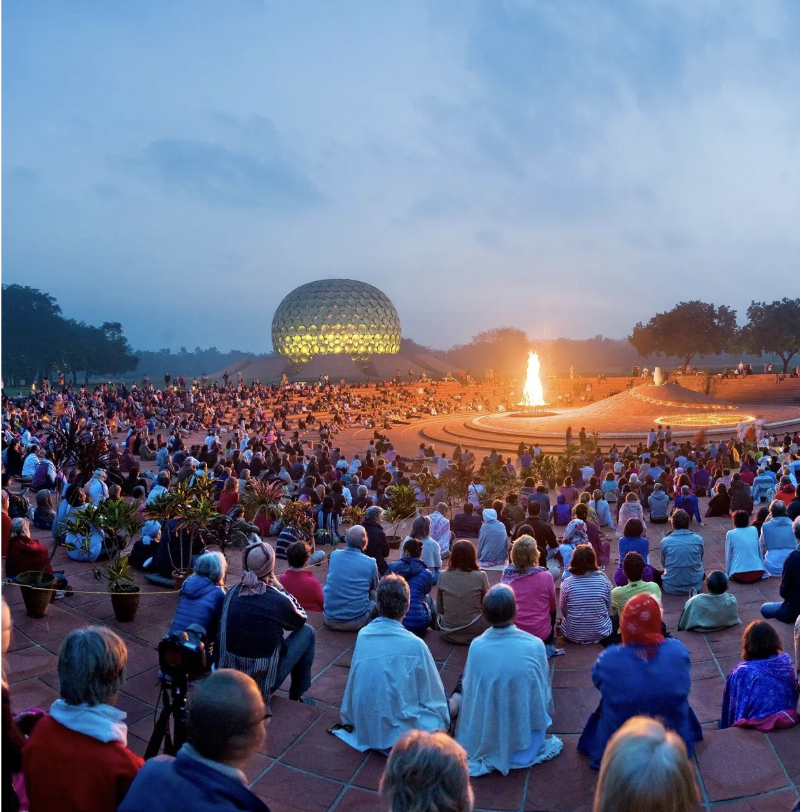
    During events like the Light Mandala meditation, people gather without being asked to behave in a particular way. Some sit still for hours, others move in and out. Children wander quietly, adults adjust positions, visitors observe.

    What’s striking is that the lack of control doesn’t disrupt the space. It strengthens it. Shared presence matters more than uniform participation.

    This approach to community allows difference without tension. It shows that cohesion doesn’t require sameness, only mutual respect.

    5. Objects Are Allowed to Have a Past

    Collection of Cameras at YATRA

    Throughout Auroville, objects show signs of use. Clothing racks hold items that have already lived full lives. Tools and equipment are repaired, reused, and stored carefully rather than replaced.

    There’s no attempt to hide age or wear. Instead, longevity is valued. Objects aren’t treated as disposable, and their history is visible.

    This approach shifts how value is assigned. Something doesn’t lose worth because it’s old; it gains it because it continues to serve a purpose.

    6. You Don’t Need to Optimize Everything

    In many environments, life is optimized down to the smallest detail. Comfort is curated, preferences are prioritized, and inconvenience is avoided whenever possible. In Auroville, optimization isn’t the goal.

    Meals aren’t customized. Spaces aren’t adjusted for individual comfort. And yet, these environments feel surprisingly welcoming. Without constant tailoring, participation becomes easier. You stop evaluating and start engaging.

    Letting go of optimization removes pressure. What’s left is a sense of ease that doesn’t rely on perfection.

    7. Sustainability Isn’t the Point, Living Is

    What stands out most is how rarely sustainability is mentioned. No one is trying to convince you of anything. Practices like reuse, shared meals, and slow movement exist without explanation.

    Because of that, they endure.

    Sustainability here isn’t treated as an identity or an achievement. It’s a byproduct of how people relate to space, time, and one another. It works because it fits into everyday life rather than standing apart from it.

    The Takeaway No One Gave Me

    Auroville didn’t offer a formula or a lifestyle to adopt. It offered a different way of paying attention. To time. To comfort. To excess.

    Sustainability here isn’t aspirational. It’s practical. It doesn’t demand perfection, only awareness. And once you start noticing how much can be gained by needing less, it’s difficult not to carry that perspective with you.

    Pondicherry Wall Art

    Written by Laura Pretel

    Tasting Solitude Farm

    By Mary Andom

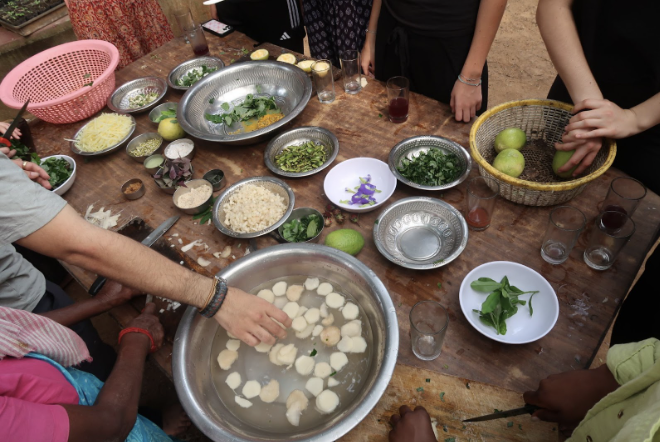
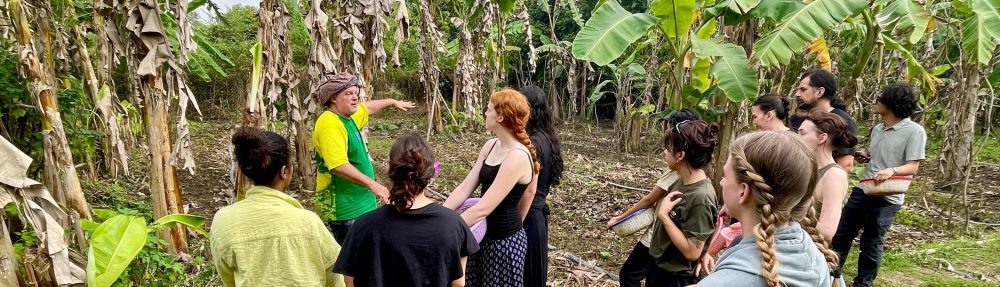
    Solitude Farm cafe is nestled in a garden oasis with brightly colored flags with printed prayers. The smell of frankincense incense, curried veggies and banana perfume the air. A British man named Krishna greets us and tell us to stand in a circle. He is wearing a saffron-colored head wrap, a green Brazilian t-shirt with khaki baggy shorts and no shoes. “Ok, take off your chappels,” he said. After all Krishna doesn’t wear shoes you can tell by the red dirt coating his nails. Krishna handed us dirt-caked baskets. “Today, you are going to harvest your lunch,” he said. Some AUP students looked pensive while others beamed with excitement. I was in the second camp. Krishna led the group of students into the forested garden. The shade of the trees allowed pockets of sunshine to beat down on us. The warm, squishy cool mud went in between our toes. Centipedes crawled and I avoided each one like a mini-landmine. Solitude Farm is an organic permaculture farm with six acres of a myriad of tropical fruits, vegetables, herbs and millet crops. The crops are indigenous and are harvested using ancient Tamil farming techniques without pesticides or chemical fertilizers. “Mary, give me your basket,” he said. A sunshine yellow lemon the size of his palm is in my basket. “These are like hand grenades,” he chuckled.

    He picked a leaf and crushes it in between his fingers. “This smells better than any Yves Saint Laurent perfume,” he said confidently. “And its all mother nature.” He passed the muddled leaves among the students, before it reached my hands the lemon herbaceous perfume wafted in to my nostrils. I couldn’t stop smelling my hands. “This is the butterfly pea flower, it is used in teas and it is a healing medicine for the hormones,” he said. He popped the flower in his mouth like a piece of candy. We each ate one. The flower tasted like a crunchy sweet pea. Krishna is very passionate about farming, for 33 years he has learned organic farming practices from around the world. Even though the tour lasted an hour time slowed down as we snaked around the tropical garden full of delicious treats. “I want to convince people by their palate, not their brains,” he said. “This herb is great for salads, it has a mushroom flavor and a delicate texture,” Krishna said passing it among the group.

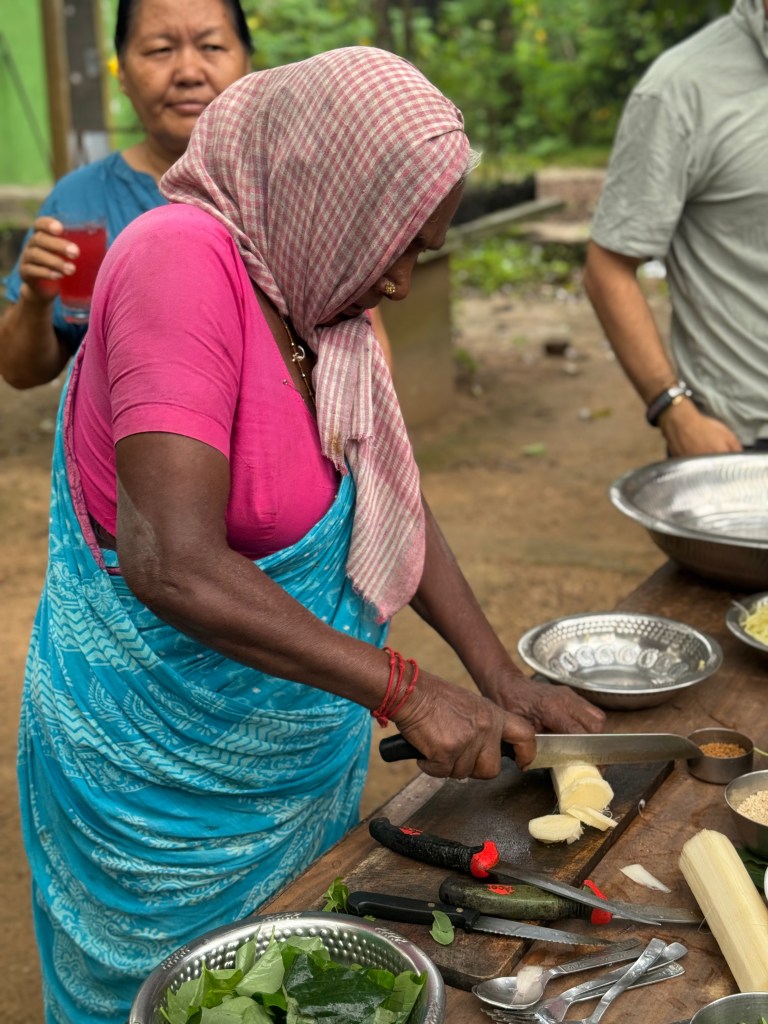
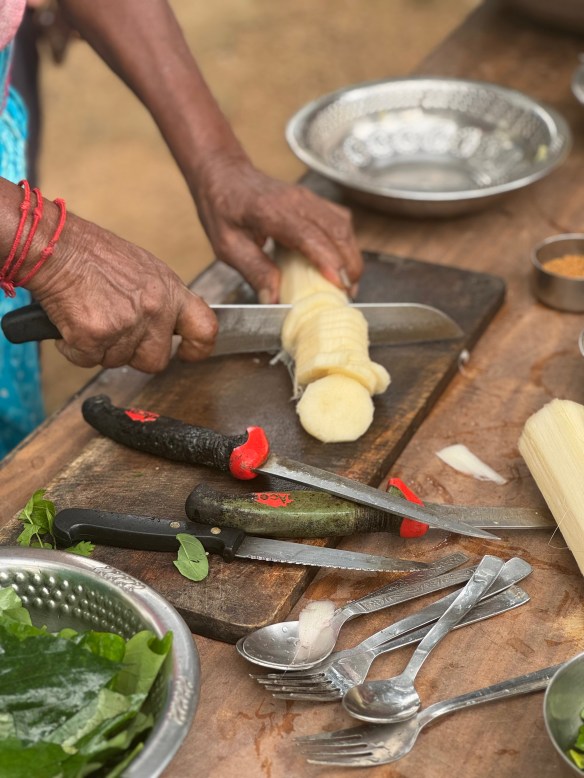
    We placed the leaves in our baskets. It is one of the reasons why I’ve visited the farm to table cafe on multiple occasions during my one month stay in Auroville. My tongue has convinced me that this type of food can be flavorful, simple and delicious. A group of Tamil ladies in brightly-hued saris chopped pumpkin on a cutting board placed on a straw mat. Another woman in her 60s with muscular forearms chopped a vegetable I have never seen or tasted in my life. It looked somewhat like sugarcane or bamboo. The white fibrous vegetable is chopped in coins and rinsed. As a team we gathered the wild spinach, lemons, flowers and placed them in a communal bowl to assemble a green papaya salad. It was amazing to taste the fruits of our table under the shade of a leafy green tree. Solitude Farm Café also serves meals made from fresh, locally grown produce, including vegan thalis, salads, smoothies, and seasonal dishes. This experience has left an impression on my heart and stomach. I’m in solitude.